
Marigolds are one of those rare plants that manage to function as ornament, kitchen-garden helper, and source of endless gardening debate all at once. Everyone has heard something about them. They repel pests. They protect tomatoes. Nematodes fear them. Wherever marigolds grow, the gardener has already half won the season.
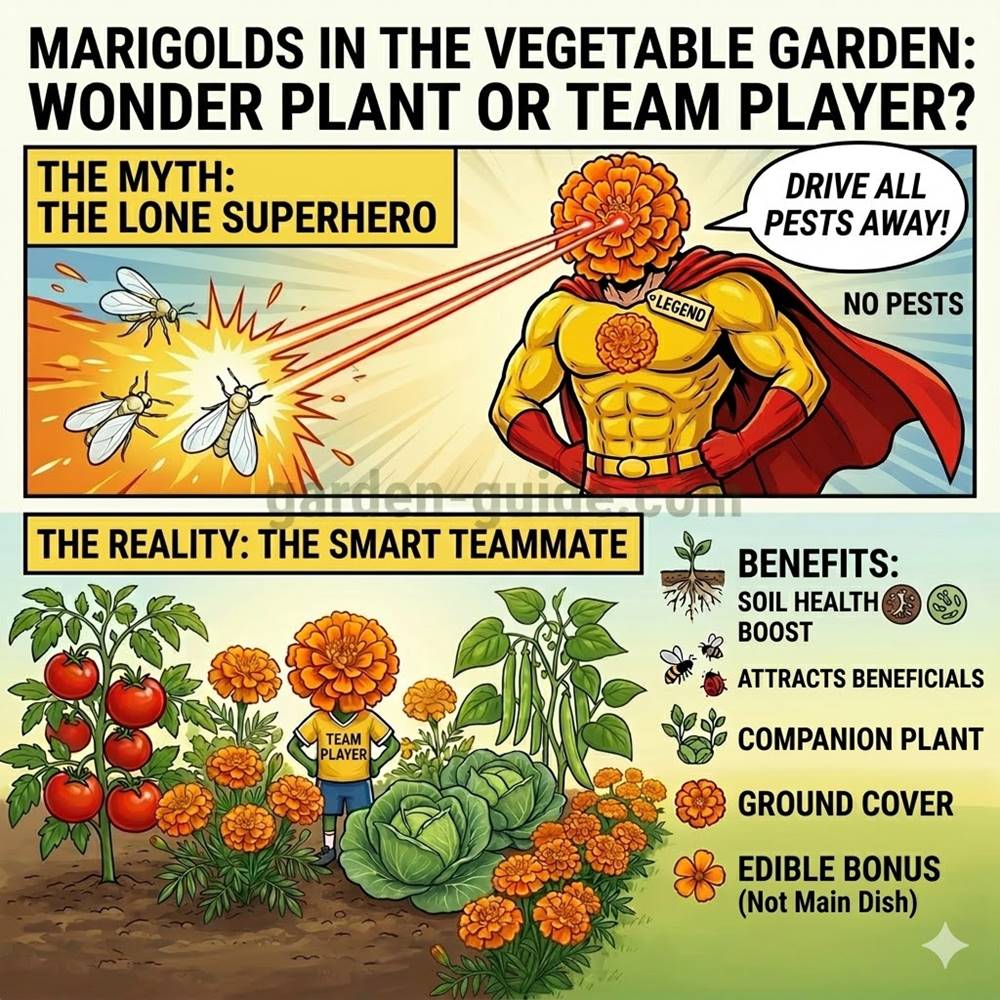
And then, of course, people plant them along the edge of the vegetable bed, lean back, and wait for them to take over the entire ministry of biological plant protection. That is where the misunderstanding usually begins. Marigolds are genuinely useful plants, but they are not orange-caped superheroes. They do not solve everything alone. What they do exceptionally well is contribute to balance in mixed planting.
I have had years when marigolds started appearing in the vegetable patch in slightly suspicious numbers. Partly by design, partly because once you let them set seed, they make it very clear they are planning a return engagement. Still, I have to give them credit: even in the strictest vegetable bed, they can bring a bit of cheer between the rows. And that is already doing more than most plants are asked to do.
Why are marigolds such stars in companion planting?
Because they are easy to grow, flower for a long time, cope well with summer conditions, and can be useful in several ways at once. They are not delicate, they do not need constant emotional encouragement to stay alive, and they look good while doing their job. In vegetable gardens they are especially valued because the flowers can attract beneficial insects, while some varieties may also play a role in reducing certain soil-related problems.
So marigolds are not merely edging plants. They are more like translators between beauty and function. They connect ornamental value with ecological usefulness. That is a remarkably good set of qualities for a plant many people still file away as just an old-fashioned cottage annual.
Companion planting is not magic. It is overlapping effects
When talking about marigolds in companion planting, it helps to cool down the hottest part of the garden folklore. Companion planting does not work because one plant becomes the official bodyguard of another. It works because different plants influence their surroundings in different ways: through scent, root activity, flowering pattern, the insects they attract, the way they shade the soil, and the visual complexity they add to a bed.
Marigolds are interesting because they can affect the system at several points. Their aromatic foliage, bright flowers, compact growth, long bloom period, and certain root exudates can make them useful companions for a range of crops.
Tomatoes and marigolds: the classic pairing
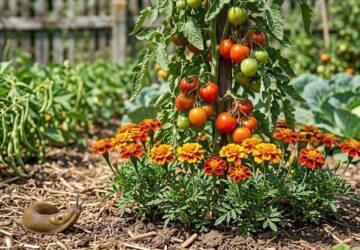
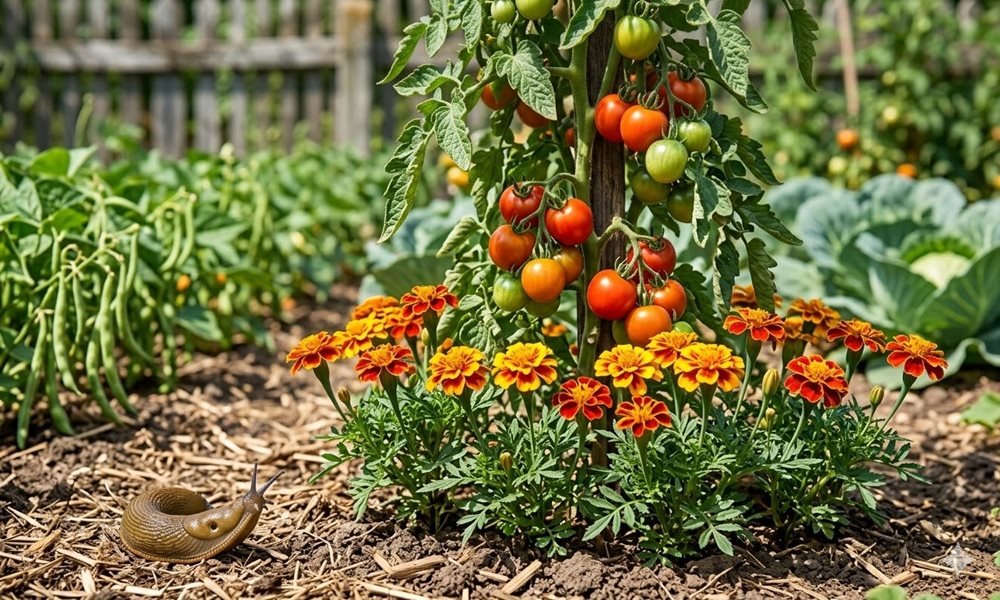
There may be no better-known kitchen-garden partnership than this one. Marigolds look excellent beside tomatoes, but the pairing is not only about appearance. Both enjoy sunny positions, and marigold flowers can help draw in insects that increase biodiversity in the vegetable patch.
People often like this pairing because marigolds help make the planting feel more layered and complex. A mixed planting can be less straightforward for pests to navigate than a long, uniform row of a single crop. That does not mean tomatoes become invincible. It means ecological resilience begins to build from many small details.
And honestly, by midseason the lower part of a tomato row is not always the finest thing the garden has ever produced. Marigolds help there too. They fill the foreground beautifully and make the whole planting look as though it was deliberately designed that way from the beginning.
They can be useful near brassicas too
Cabbage, kale, broccoli, and cauliflower are not always surrounded by peaceful gardening serenity. There are caterpillars, various insects, and a general sense that something is always planning a meal. In these beds, marigolds are especially useful as flowering companion plants that break up visual monotony and draw more beneficial insects into the area.
One of the less dramatic but more important strengths of companion planting is that it does not search for one miracle cure for one problem. It tries to create a more balanced growing environment. Marigolds will not personally resolve every cabbage-white issue in the garden, but as part of a mixed planting they can absolutely play a helpful role.
Beans, peppers, potatoes: why are marigolds so often planted with them?
Marigolds are often recommended near beans, peppers, potatoes, and other common crops for a couple of reasons. One is that they tolerate sunny, warm conditions well and do not necessarily overwhelm their neighbours when placed sensibly. Another is that some species and cultivars are especially well known for what happens around their roots.
Their reputation regarding nematodes is not entirely invented, but it does need careful wording. Not every marigold, not every nematode, and not every garden situation works the same way. In many cases it is French marigold, Tagetes patula, and certain selections of it that are most often mentioned in this context. Even then, the effect is not instant, and it makes the most sense as part of a thoughtful system that also includes rotation and healthy soil management.
So marigolds do not “banish” soil problems in the fairy-tale sense. In some cases they may help create a more favourable root-zone environment. That version is less magical, but much more useful.
What plants are they good with?
The best companion combinations are usually the ones where the plants’ needs are broadly compatible. Marigolds are sun-loving, warmth-loving annuals that do well in ordinary garden soil. Because of that, they often combine well with:
- tomatoes
- peppers
- eggplants
- beans
- potatoes
- cucumbers in sunnier positions
- brassicas
- lettuce along the edge of a bed
- herbs such as basil or dill in a mixed vegetable plot
The important thing is not just whether they can go together. It is whether everybody still has enough room. Marigolds are not giant aggressors, but if planted too densely, they can still push into the space like any enthusiastic annual.
And where are they less suitable?
It is not that marigolds have a long list of enemies. It is more that they do not show their strengths well in shady, overly wet, or badly crowded conditions. If you squeeze them behind a large, dense crop that blocks all the light, then the companion planting mostly becomes theoretical. Yes, they are technically there. No, they are not having a good time.
Marigolds dislike permanently wet soil, and they do not thrive in airless, cramped conditions either. So good companion planting is not just a species list. It is also spatial design. A lot of garden trouble starts when, in theory, everything is “compatible,” while in practice twenty plants are all trying to build a future on the same half square metre.
And then the slugs arrive and eat them to the ground
Yes, this is a very real frustration, and gardeners mention it all the time. You plant marigolds with the best companion-planting intentions in the world, and by the next morning the slugs have reduced them to decorative stumps. At that point it becomes difficult to feel poetic about plant partnerships.
The reason is simple enough: young marigold leaves and shoots can be very appealing to slugs, especially when the plants are newly set out and still soft. So while marigolds may have a strong reputation in relation to certain soil pests or ecological benefits, above ground the situation can be much less heroic. The slug has not read the companion planting article. It is just having dinner.
This tends to be worst in wet springs, in lush mulched beds, in dense humid plantings, or where evening watering keeps the surface damp for longer. In those conditions, marigolds may function less as clever companion plants and more as a well-advertised snack. And yes, that can absolutely derail the whole plan, especially early in the season.
What can you do so the slugs do not win the experiment?
The main thing is to plant marigolds with the real garden in mind, not just the ideal one. If slugs are a recurring problem, it helps to set out stronger, more established plants rather than the tiniest seedlings, because slightly larger plants have a better chance of surviving the first attacks.
It also helps to reduce obvious hiding places right around them. Permanently wet mulch, boards, stones, dense plant debris, and evening watering can all make life easier for slugs. That does not mean giving up on ecological gardening. It just means managing the marigolds a bit more deliberately during the vulnerable early stage.
Some gardeners therefore use temporary physical protection, hand-picking, morning inspections, or targeted slug control during the first critical weeks, especially in gardens where this happens every year. Because however useful marigolds may be later, they still need to survive long enough to become useful.
So does that ruin companion planting altogether?
Not necessarily. It simply shows that companion planting is not a fairy tale but a system. Marigolds can be excellent companion plants, but only if the plants themselves stay alive. One of the most common disappointments in gardening comes from hearing a lot about the benefits of marigolds and much less about how vulnerable they can be when young.
So the realistic sentence is not “marigolds will solve everything.” It is “if you can get them established, they can contribute a great deal.” Sometimes they just have to make it past the slug-controlled border first.
They are worth using for beneficial insects alone
Marigolds bloom for a long time, stand out clearly, and provide reliable colour through much of the summer. That is not only good for us. It is good for pollinators and other useful insects too. A vegetable garden with flowering companion plants usually feels much more alive than one arranged as a sterile sequence of green rows.
One of the great strengths of companion planting is exactly this: it turns the garden from a mere production surface into a functioning habitat. Marigolds are excellent partners in that kind of design because they are easy to grow, long-flowering, and not at all demanding.
They are edible too — but not in a soup-bowl sort of way
Some marigold petals are edible and can be used decoratively in salads and other dishes. That does not make them a staple crop. It is more of a charming garden bonus. As always, only correctly identified, chemical-free plants should be considered for eating.
This is a pleasant side note rather than the main reason to grow them. The real strength of marigolds remains the way they fit into the structure and ecology of the vegetable garden.
How should you plant them if companion planting is the goal?
The best approach is not to squeeze them in as an afterthought, but to include them when planning the bed. They can go at row ends, along borders, rhythmically between tomatoes or peppers, or in repeating clusters across a larger bed. There is no need to assign one marigold as a personal guard to every vegetable. In fact, they usually work better in small groups or thoughtfully spaced patches.
They also improve the appearance of the kitchen garden enormously, and there is no need to apologize for that. Companion planting is not only about pest management or ecology. It is also about design. A beautiful vegetable garden gets observed more often, problems are noticed sooner, and people are more inclined to care for it properly.
So, is it really worth planting marigolds?
Yes, as long as it is for the right reason. Not because they will solve every problem alone, but because they are smart companion plants. They can support biodiversity, make the bed more attractive, contribute to more thoughtful planting design, and in some cases help influence soil conditions and pest pressure in a favourable direction.
Marigolds are not miracle weapons. They are better than that: easy to use, resilient, cheerful plants that help the vegetable garden do more than simply produce crops. They help it function better.
And honestly, if one plant can be useful, beautiful, and just a little delightfully retro in the same bed, then marigolds have absolutely earned their place in the modern garden.