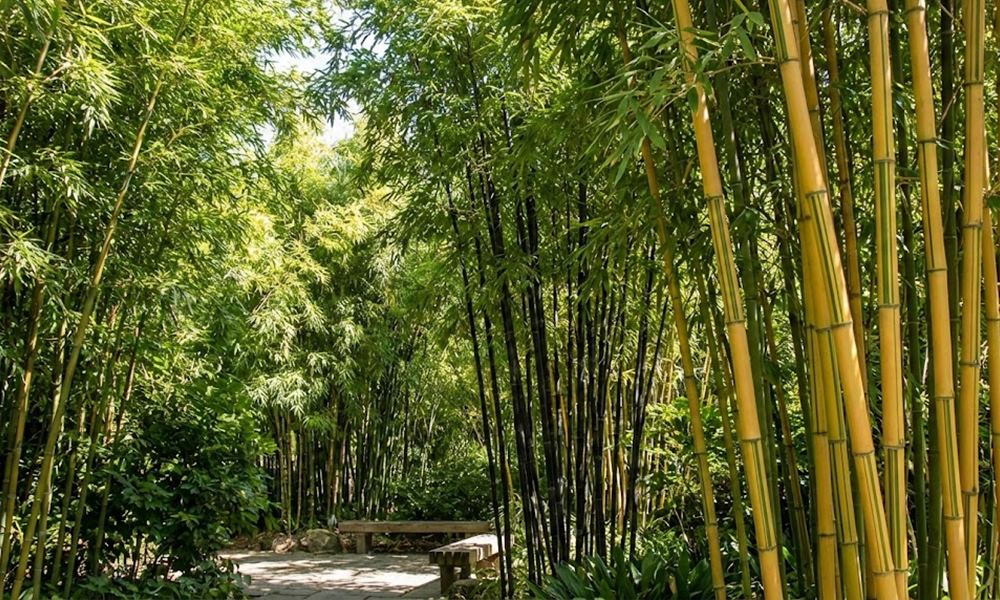

Most Phyllostachys species are running bamboos. This is part of their charm — and their challenge. Underground, they produce vigorous rhizomes that travel horizontally and send up new shoots several metres away from the original plant. Left unmanaged, a bamboo planting can expand steadily each year. In the right setting this creates a lush grove effect. In a small garden, however, it can become overwhelming.
Do You Need a Root Barrier?
In most domestic gardens, yes. Install a high-density polyethylene (HDPE) rhizome barrier at least 60–70 cm deep around the planting area. The barrier should be slightly angled outward so that rhizomes are guided upward rather than diving beneath it. This makes wandering shoots easier to spot and remove. A barrier doesn’t weaken the bamboo — it simply defines its territory.
How Bamboo Actually Grows
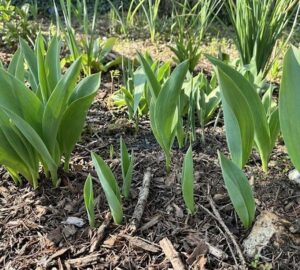
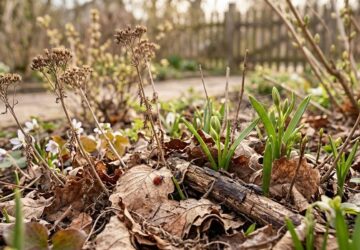
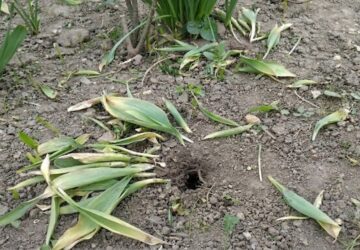
In spring, new shoots (often called “spears”) emerge rapidly from underground rhizomes. Within a few weeks they reach their full height for the year. Unlike trees, bamboo culms do not continue elongating year after year — each shoot achieves its maximum height in a single season. Monitoring the perimeter each spring allows unwanted shoots to be removed easily while still young.
Pruning and Maintenance
Bamboo is thinned rather than pruned. Removing older culms at ground level improves air circulation and highlights the beauty of the remaining canes. For hedge use, foliage height can be trimmed.
Light and Soil
Full sun encourages strong cane colour, though partial shade is tolerated. Fertile, well-drained soil and consistent moisture during establishment are key to success.
Handled thoughtfully, bamboo becomes living architecture — dramatic yet controlled, dynamic yet deliberate.
When the Garden Begins to Whisper – The World of Hardy Phyllostachys Bamboos
Bamboo is not merely a plant — it is atmosphere. It filters light, rustles in the wind, reshapes space. Exotic in character, yet surprisingly hardy in Central European climates.
The genus Phyllostachys includes some of the most reliable temperate bamboos. Vigorous and running in habit, they require thoughtful root control but reward gardeners with dramatic vertical structure.
Golden Grooves and Sunlit Canes – Phyllostachys aureosulcata
A robust and dependable species reaching 5–8 metres.
- Standard form: green culms with a distinctive yellow groove.
- ’Aureocaulis’: golden-yellow canes with green striping.
- ’Spectabilis’: vivid yellow culms boldly marked with green.
Excellent for screening and movement.
Architectural Giants – Phyllostachys bambusoides
Capable of 8–12 metres, this Japanese species creates true bamboo groves.
- ’Castillonis’: yellow culms with green striping.
- ’Violascens’: young culms flushed with purple tones.
- Species form: classic strong green.
Best suited to larger gardens.
Reliable Screening – Phyllostachys bissetii
Dense, hardy and wind-tolerant. A favourite for evergreen privacy hedges.
Elegant and Refined Choices
- Phyllostachys decora
- Phyllostachys flexuosa
- Phyllostachys glauca
These offer lighter texture and subtle colour variations.
Distinctive Personalities
- Phyllostachys heteroclada (tolerates wetter soils)
- Phyllostachys humilis (smaller stature)
- Phyllostachys nigra (black bamboo)
- P. nigra ‘Boryana’ (leopard-spotted culms)
- P. nigra ‘Henonis’ (grey-green tones)
Strong Greens and Colour Variants
- Phyllostachys nuda
- Phyllostachys rubromarginata
- Phyllostachys viridis
- P. viridis ‘Sulphurea’
- Phyllostachys vivax ‘Aureocaulis’
Running vs. Clumping Bamboo – Understanding the Difference
This is a distinction worth clarifying before planting.
Phyllostachys species are running bamboos. Their underground rhizomes travel horizontally and can produce new shoots at some distance from the original clump. This allows them to create impressive grove-like effects — but also means they require management.
By contrast, clumping bamboos (such as species in the genus Fargesia) grow in tight clusters. Their rhizomes are short and do not travel aggressively, making them more suitable for small gardens where root barriers are undesirable.
If you’re seeking fast screening and bold structural impact, running Phyllostachys varieties are excellent — provided you install proper containment. If ease of control is your priority, clumping types may be the wiser choice.
The decision is not merely aesthetic; it’s about long-term garden management.
How Large Should a Root Barrier Be? – Practical Sizing Guide
Depth matters — but so does diameter.
Small ornamental grouping (1–2 plants):
Create a contained circle at least 1–1.5 metres in diameter.
Screening hedge:
Install a continuous barrier along the entire planting line, 60–70 cm deep. Allow a planting strip at least 80–100 cm wide so the bamboo can thicken naturally.
Grove-style planting in larger gardens:
Even here, define a boundary. A 2–3 metre diameter containment zone allows a more natural woodland feel while keeping expansion controlled.
Important: leave the top edge of the barrier 3–5 cm above soil level. Surface-running rhizomes are easier to detect and remove before they escape.
An annual perimeter check is usually sufficient. Bamboo is vigorous — but with clear boundaries, it remains an elegant structural partner rather than a problem.
Growing Considerations
Most Phyllostachys species are running bamboos; installing a rhizome barrier is highly recommended. They prefer sun and fertile, well-drained soil. Regular watering supports establishment.
Bamboo is not just planting — it is spatial design. Used wisely, it creates living architecture in the garden.