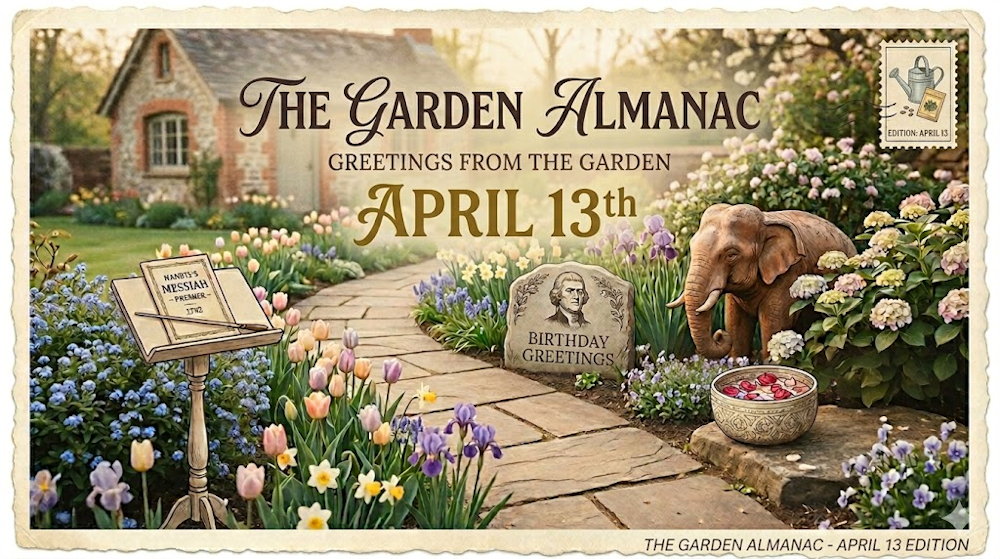

A Date That Opens Outward. April 13 is the kind of spring date that seems to expand as soon as one begins looking at it. It carries music, curiosity, seasonal renewal, and a widening sense of the world. In some places it is marked by New Year celebrations and water rituals; in others it recalls first encounters with the unfamiliar, or works of art that went on to outlive their own evening.
For an almanac, this makes April 13 especially attractive. It is a day about emergence, and emergence is one of spring’s deepest themes.
Handel’s Messiah Premieres in Dublin
On April 13, 1742, George Frideric Handel’s Messiah was first performed in Dublin. Over time it became one of the most enduring choral works in the world, but on that first evening it was simply a new work entering the air for the first time.
That moment matters in an almanac because spring often feels like that too. Something long prepared finally becomes audible. A garden moves the same way: roots work in silence for weeks, then one morning the season seems to have found its voice.
The First Elephant Arrives in America
On April 13, 1796, the first elephant to arrive in the United States reached New York. For the people who saw it, the animal must have seemed almost unreal — a living sign that the known world had suddenly widened.
This belongs beautifully in an almanac. Gardens also teach enlargement of imagination. A seed from elsewhere, an unfamiliar species, a new blossom or scent — all of these can expand the boundaries of what feels possible in one’s own patch of earth.
Songkran and the Power of Water
April 13 also marks the beginning of Songkran, the Thai New Year festival, celebrated with water, cleansing, blessing, remembrance, and renewal. Beneath the joyful public splashing lies an older logic of respect, purification, and seasonal transition.
That gives April 13 a strong spring symbolism. Water does not only refresh; it also marks passage. It clears, blesses, and prepares. In the garden too, water is rarely just practical. At the right moment, it becomes the sign that a season has truly turned.
Thomas Jefferson and the Ordered Landscape
April 13, 1743 was the birthday of Thomas Jefferson, whose legacy reaches far beyond politics into architecture, horticulture, and landscape design. His fascination with cultivated order, useful planting, and the relationship between mind and land makes him an unexpectedly fitting figure for an almanac.
Spring is always partly about design. What will grow where? What belongs together? How should a place be arranged so that beauty and use do not quarrel? April 13 can therefore also be read as a day of thoughtful arrangement.
What To Notice In The Garden Today
April 13 is an especially good day for noticing what makes a garden feel more spacious than it did a week ago.
- Which part of the garden has most clearly opened up?
- Where has water changed the mood or pace of growth?
- What new form, scent, or colour has entered the scene?
- Which area now feels ready to be shaped more deliberately?
- What in the garden seems to have found its voice?
An almanac date is not only a record of events. It is also a lens that sharpens what is happening close at hand.
The Meaning Of April 13
April 13 gathers together first performances, first encounters, ritual cleansing, and the ordering of cultivated space. Through Messiah, the elephant in New York, Songkran, and Jefferson, the day becomes a meditation on widening experience.
That is a very springlike lesson. The world does not only bloom in April. It also grows larger.