
Blackberries have a slightly misleading personality. When they are fruiting well, people tend to think of them romantically: glossy dark berries, summer snacking, jam, crumble, cottage-garden charm. Then spring arrives and reveals the truth. A blackberry is not just a fruiting plant. It is also a determined expansion strategy with leaves.
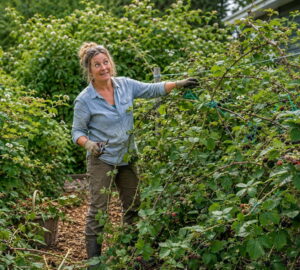
I had a blackberry row like that once. I approached it one spring with absurd optimism, convinced I would just take a quick look and everything would somehow make sense. It did not. What waited for me was a tangled, thorny thicket that made me instinctively check whether I had sturdy sleeves, secateurs, and enough inner peace to continue. Blackberries are generous plants, but they are not the sort that transform neglect into poetry all by themselves.
The encouraging part is that spring is exactly when a lot can be fixed. Blackberry plants respond well to a bit of structure, and they usually repay it with very decent fruit.
Spring blackberry care is really just organized common sense
The main jobs are sorting and thinning the canes, tying them into support, improving the soil, and getting water management right. It sounds like a lot until you realize all of it points in the same direction: stop the plant from investing energy in chaos and redirect it toward cropping.
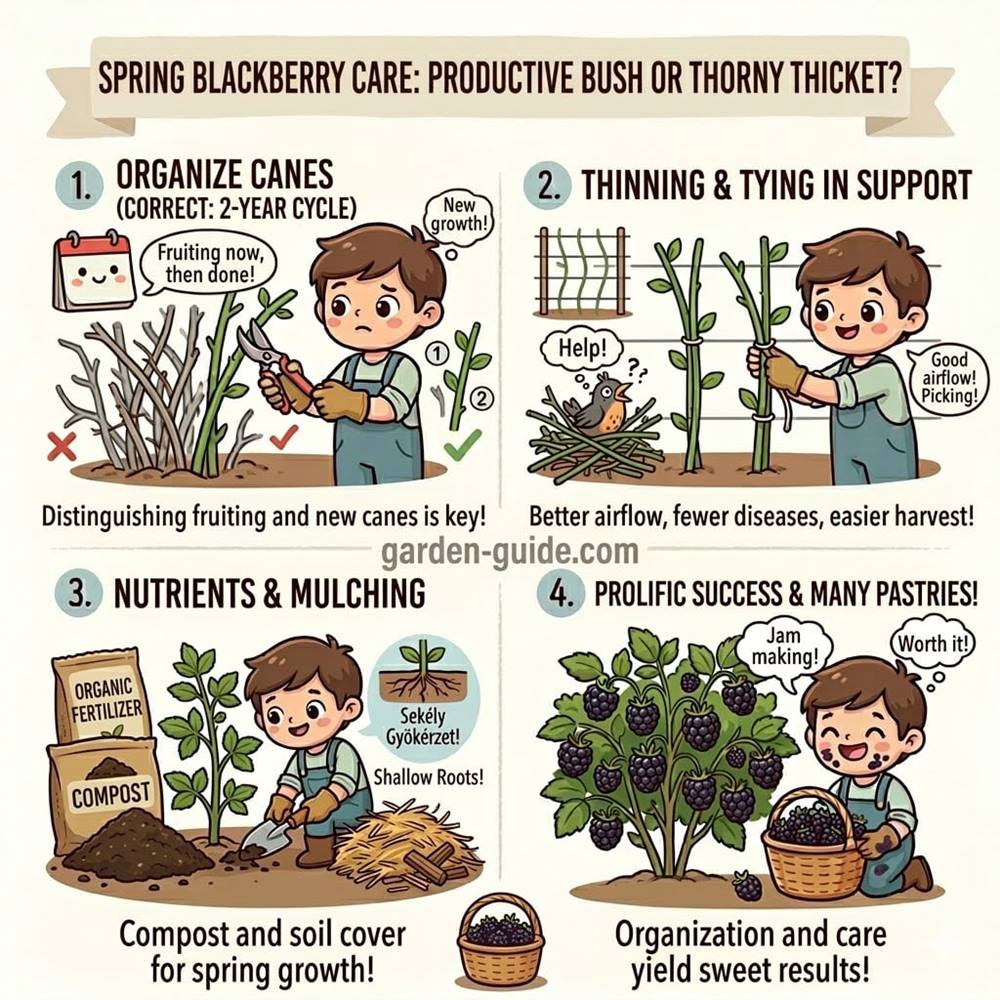
It also helps to understand how blackberry canes work. Most blackberries follow a two-year cycle. In the first year, a cane grows. In the second, it fruits. After that, its career is basically over. It is one of those ruthlessly practical gardening truths. What looked like future promise last year may now be taking up space.
1. Remove weak, damaged, and badly placed canes
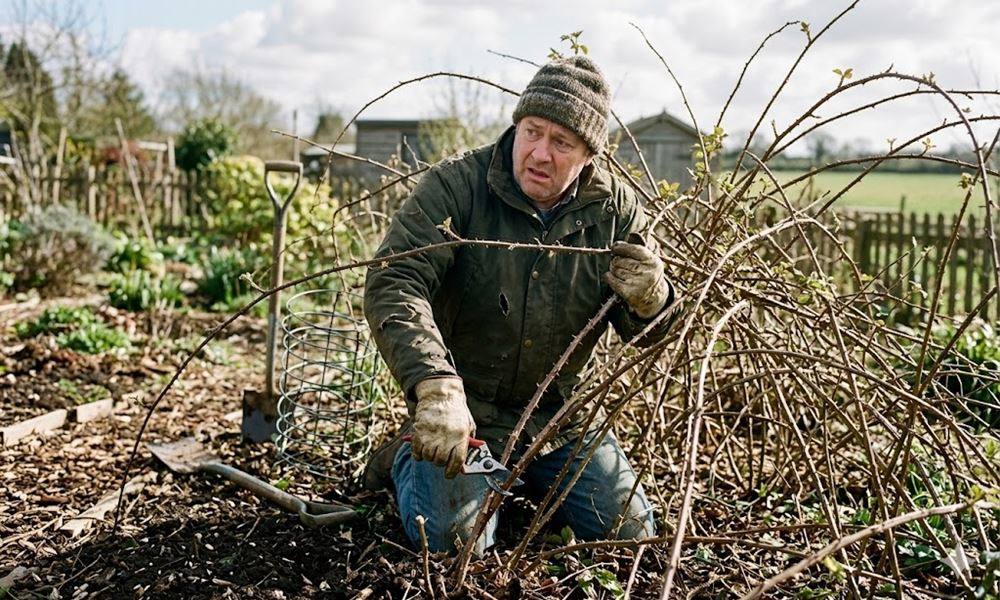
The first spring task is to inspect the plant or row and remove any damaged, frost-hit, diseased, or very weak canes. Blackberries can become crowded quickly, and once that happens, airflow drops, light penetration worsens, and harvesting starts to feel like a prickly obstacle course.
Horticultural guidance regularly points out that a more open structure brings several benefits. Better air circulation means the plant dries faster after rain, disease pressure is reduced, and berries tend to develop better. Put simply, a blackberry is not happiest when it has the most canes. It is happiest when the canes it has are actually useful.
There is no need to get sentimental about old, spent fruiting canes. The plant is not attached to them. Usually it is the gardener who hesitates. Blackberries, on the other hand, appreciate direct communication delivered through pruning tools.
2. Training and tying in the canes solves half the problem
Blackberries behave much more politely when given support. Wires, posts, a fence, or another stable framework can make an enormous difference. Long canes stay off the ground, stop collapsing into everything nearby, and become much easier to manage.
A trained blackberry is not only neater but also far easier to harvest. In spring, that may sound theoretical. By July, when you are trying to pick berries without donating part of your sleeve to the plant, it becomes very practical.
Many gardeners tie current fruiting canes to one side and new canes to the other. It is an excellent system because when the old canes finish, removal becomes much simpler. With blackberries, the smartest decisions are often the ones that reduce future irritation before it happens.
3. Loosen the soil, but do not launch a ground assault
In spring, it helps to gently loosen the soil around the base, especially if the surface has compacted or crusted over. This improves water penetration and helps the root zone breathe. Gently is the key word here. Blackberry roots do not need to be treated as if an entire season’s problems will be solved by one enthusiastic digging session.
Shallow cultivation is enough. The goal is not a military operation. The goal is simply to make the soil easier for the plant to live in.
4. Compost and nutrients give the plant a proper start
Blackberries need access to nutrients if they are going to produce strong growth and good crops. Spring is a good time to apply compost, well-rotted manure, or a moderate, balanced feeding approach. At this stage the plant is trying to grow new canes, expand its leaf area, and prepare for fruiting.
More is not automatically better. Too much nitrogen can lead to lush growth that looks impressive but does not necessarily translate into better fruit. Soft, overly vigorous growth may also be more vulnerable. A good gardener does not overfeed the blackberry. They simply make sure it has a sensible breakfast.
Compost is especially helpful because it improves soil structure as well as fertility. Blackberries respond well to soil that holds moisture without turning stagnant and stays airy without drying out too fast.
5. Mulching helps here too
Mulch is valuable around blackberries for all the familiar reasons. Straw, leaf compost, bark, or another organic mulch can help conserve moisture, suppress weeds, and moderate soil temperature.
This is especially useful in spring, when growth is beginning but soil moisture may still fluctuate wildly. Mulch works a bit like sensible layered clothing in unpredictable weather. It protects, stabilizes, and prevents unnecessary stress.
Just do not pile it thickly right against the crown. The aim is protection, not suffocation.
6. Water should stay steady, not theatrical
Blackberries perform best when soil moisture stays reasonably even during spring growth and later fruit development. Overwatering is not helpful, but neither is allowing the plants to go through repeated dry spells. If the plant starts spring already under water stress, that tends to echo through the rest of the season.
The best system is not heroic intervention. It is steady observation. Watch the soil, the weather, and the plant. Blackberries are less impressed by dramatic rescues than people imagine. They are happier when you do not keep putting them into avoidable crises in the first place.
7. In spring, light and air count as nutrients too
It is easy to focus only on fertilizer and watering, but light and airflow are just as important. If canes are too crowded, they shade each other, stay wetter for longer, and create poorer conditions for fruit development.
So spring thinning is not plant cruelty. It is quality control. With blackberries, less really can mean more. Fewer unnecessary canes, more intact gardener nerves, and better fruit.
8. Check what winter has done
A lot only becomes obvious in spring. Cane tips may be winter-damaged, ties may have rubbed or loosened, and supports may need repair. This is the right time to deal with those things, because once vigorous growth begins, every small fix becomes more awkward.
In spring, blackberries are still relatively cooperative. By midsummer, they tend to act as though any late-arriving human should have planned better.
So what is the core of good spring blackberry care?
In brief: thin the canes, organize them, use support, add compost, mulch well, keep moisture even, and think a little ahead. That is really it. And yet those few steps make the difference between a manageable, productive planting and a spiky garden test of character.
Blackberries are not malicious plants. They are just energetic. If you get that energy moving in the right direction in spring, then summer is much more likely to feel like berry season and much less like an endurance event.
And that, in the end, is why we grow them. Well, that and the fact that freshly picked blackberries make people remarkably willing to forgive a few thorny remarks.