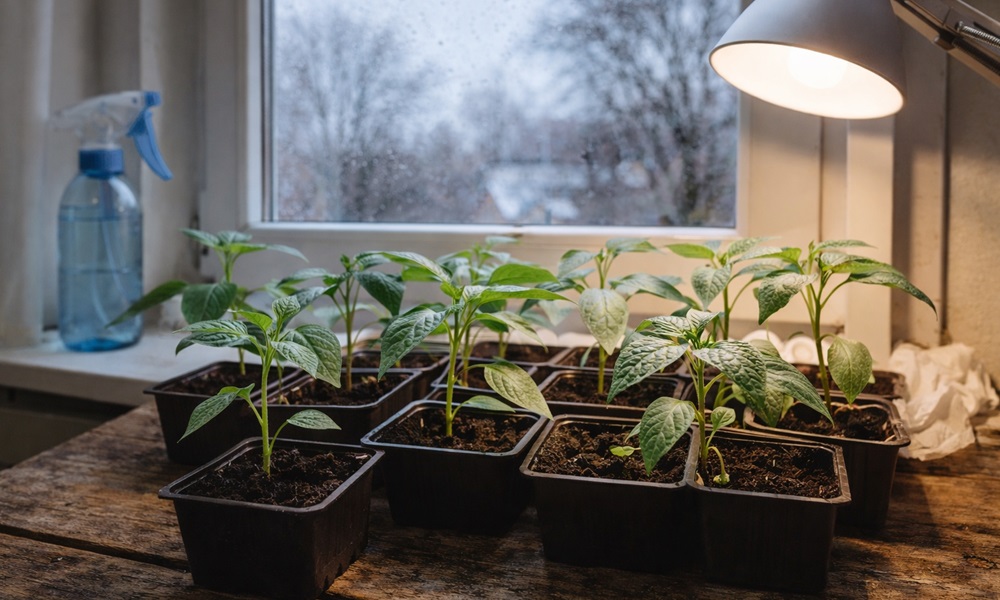

Pepper seeds germinate happily in a warm room, and within days the first tiny leaves appear. Optimism kicks in: the season has started. Two weeks later, however, the seedlings may suddenly stretch, thin out, and begin to lean. The question is always the same: do you actually need a grow light, or is the windowsill enough? The answer isn’t universal. Not every February seedling requires artificial light — but there is a clear point when it becomes necessary.
What Does Light Deficiency Really Mean?
Peppers are warmth-loving plants, but they are just as light-hungry. When light levels are low, the plant doesn’t simply slow down. It reaches. Stems elongate, leaves remain smaller, and tissues become weaker. That stretch cannot be reversed. Once a seedling becomes spindly, it won’t later turn compact and sturdy.
When Is a Windowsill Enough?
Pepper seedlings can remain compact in a window if:
- the window faces south or southwest,
- there is no balcony railing, dense tree canopy, or heavy shading outside,
- the trays sit directly next to the glass and
- the pots are rotated regularly.
In the second half of February, during brighter spells, this setup can be sufficient in many homes.
When Is Supplemental Lighting Almost Certain to Be Needed?
You will likely need additional light if:
- the window faces north,
- seedlings are positioned 30–50 cm away from the glass,
- overcast weather persists for days or
- stems visibly elongate within a short time.
If the seedlings are clearly “searching” for light and beginning to lean, they’re already signaling a deficit.
It’s Not About the Lamp — It’s About Balance
Many gardeners rush to buy powerful grow lights while overlooking basic conditions. Temperature control and careful watering are just as important.
Peppers develop best with roughly 12–14 hours of strong, even light. If natural daylight cannot provide that, supplemental lighting helps restore the balance.
A Common Mistake
Placing the light too high. For seedlings, the light source needs to be relatively close — without overheating or scorching the leaves. If the lamp is too far away, stretching continues.
The Decision Is Simpler Than It Seems
The real question isn’t whether grow lights are “allowed,” but what the seedlings are showing you.
If they are compact, deep green, and have sturdy stems — they’re fine. If they are pale, thin, and starting to lean — they need more light.
In late winter, the most common problem indoors isn’t cold. It’s insufficient light. Strong seedlings don’t rush. They build on solid foundations.
Depending on climate and latitude, this light dilemma appears at different moments. In cool–temperate regions it often becomes critical in late winter, while in milder, sunnier climates natural light may already be sufficient earlier. The principle remains universal: observe the plant’s structure, not the calendar.