
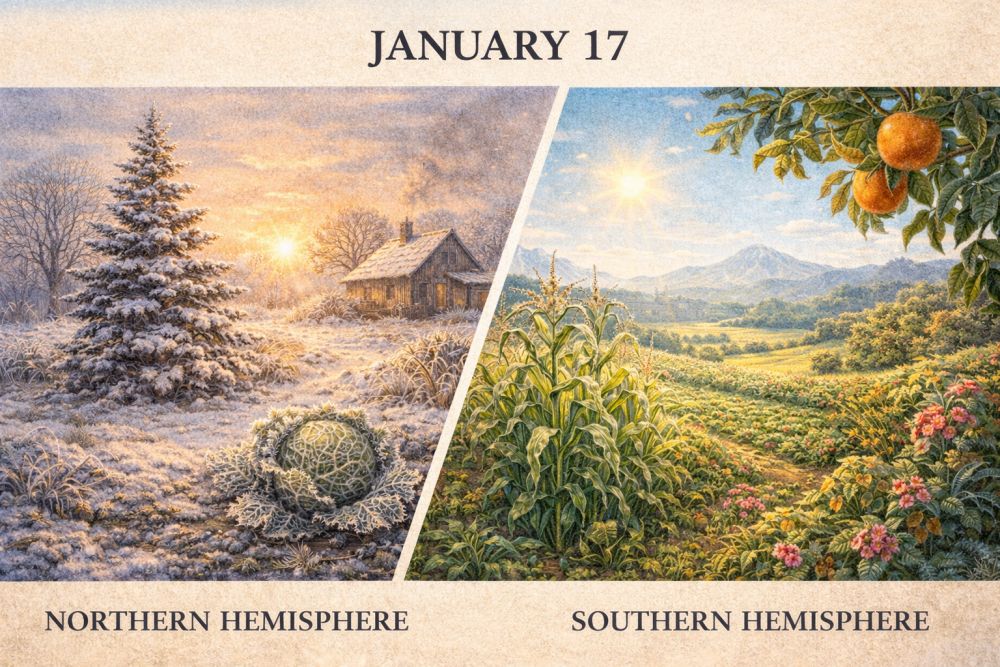

January 17 is one of those rare dates when the garden means something entirely different depending on where you stand on the planet. While much of the Northern Hemisphere remains locked in winter stillness, elsewhere growth accelerates, grasses awaken, or life races against time. Old calendars did not mark this day with celebration — but across continents, it was quietly observed.
What unites these distant traditions is a shared awareness: January 17 reveals how deeply plants are shaped by place, climate, and timing.
Europe: When Winter Stops Deepening
In many parts of Europe, January 17 was considered a psychological turning point. Folk observation held that winter had reached its full strength. From this point on, cold might persist, but it would not intensify.
For plants, this mattered. By mid-January, dormancy was no longer a reaction to cold but a stable state. Trees, shrubs, and perennials had completed their internal adjustments, conserving energy and resisting damage rather than responding anew to each frost.
Gardeners learned that little could be gained from intervention now. The season demanded endurance, not correction.
Africa: Watching for Green on the High Plateaus
In East African highland regions such as Ethiopia and Kenya, January sits at the edge of survival and renewal. Pastoral communities watched closely for the first subtle signs of grass recovery after dry periods.
The appearance of even sparse green shoots could determine grazing routes and animal movement. Plants that survived here did so through deep root systems and rapid response once moisture returned.
January 17 belonged to careful observation — not action — as decisions made too early could exhaust both land and livestock.
Asia: When Spring Begins Underground
In East Asian seasonal philosophy, mid-January marks the deepest point of winter’s inward force. From here, the balance begins to shift.
Although the surface remains unchanged, roots become more active below ground. Energy stored earlier in the season is redistributed, setting the stage for later growth.
This concept aligns closely with modern plant science, which shows that root systems often remain metabolically active even when above-ground growth is fully dormant.
North America: Lessons from Evergreens
For many Indigenous communities of North America, January was a time to observe plants that endured winter openly. Evergreens — pines, spruces, junipers — were seen as teachers.
Their needles, coated in wax and shaped to shed snow, demonstrated survival through conservation. These plants did not grow during winter; they endured it efficiently.
January 17 became a reminder that survival itself is an achievement, not a pause between productive seasons.
South America: When Growth Must Be Controlled
South of the equator, January tells a different story. In regions of South America, this period falls in the heart of the growing season.
Abundant warmth and moisture drive rapid plant expansion. Farmers and gardeners learned that unchecked growth could weaken plants, reduce fruiting, or invite disease.
Pruning, thinning, and restraint became essential skills — proof that growth, like dormancy, requires balance.
Antarctica: Life at the Edge of Possibility
On the southernmost continent, January 17 occurs during the brief Antarctic summer. Mosses and lichens seize a narrow window of activity, completing growth cycles in weeks.
These plants demonstrate the extreme limits of plant life, reminding us that seasonality is not measured by months, but by opportunity.
One Date, Many Gardens
January 17 reveals a powerful truth: there is no single garden season.
While one landscape waits, another advances. While some plants endure, others race forward. Across cultures and climates, this date was never about uniform action, but about understanding context.
The lesson is universal. Successful gardening begins not with the calendar, but with attention.
That awareness — shaped by place, patience, and respect for natural rhythms — is what earns January 17 its place in The Garden Almanac.