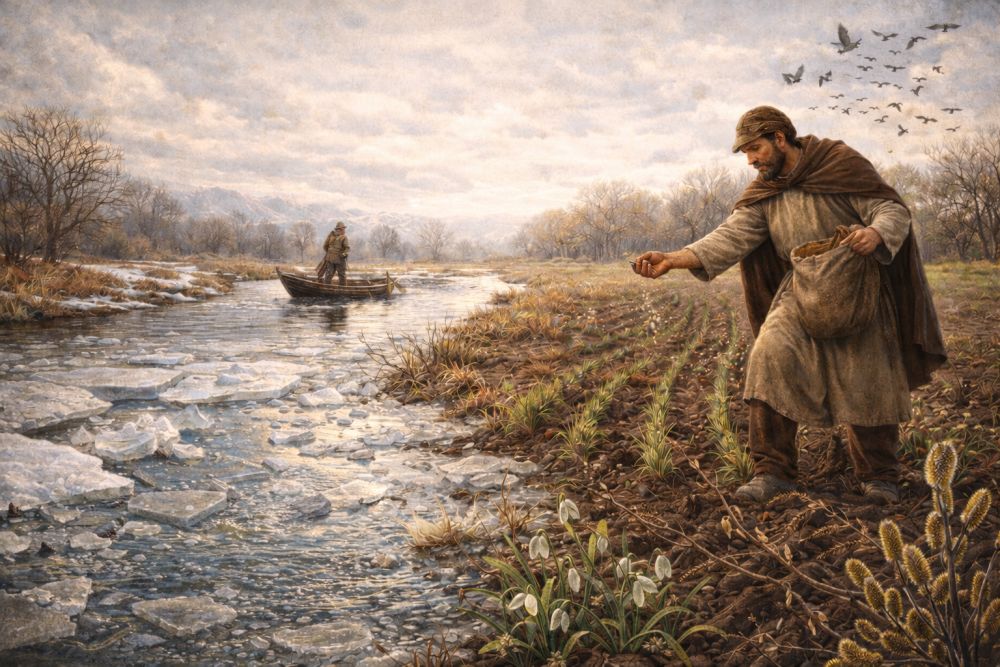

In Central European tradition, February 24 is associated with St. Matthias and with a turning point in late winter. Folk sayings claim that if Matthias finds ice, he breaks it — but if he finds none, he makes it.
Weather and the Forty-Day Rule
Another belief holds that frost on this night means forty more cold nights ahead. Such “forty-day” reckonings appear frequently in European seasonal lore, marking extended transitional periods. Similar patterns can be found in Candlemas traditions (February 2) and even in North American Groundhog Day customs — all rooted in the human desire to predict the length of winter.
Across Europe, late February served as a meteorological checkpoint: farmers observed frost depth, snow cover, and ice thickness on rivers to estimate how quickly fieldwork could begin.
Early Sowing and Agricultural Signals
Some communities associated this date with early sowing rituals. Seeds planted symbolically on this day were thought to resist pests. While modern agronomy would caution against sowing into cold soil, the custom reflects awareness that soil temperature and moisture at the end of February strongly influence germination.
Water, Fish, and Thaw
In regions where rivers froze solid, late February often marked the beginning of weakening ice. Fishing traditions connected catches on this day with luck for the year ahead. The slow breakup of ice signaled ecological change beneath the surface.
Comparable late-winter observations appear in Scandinavian, Alpine, and Slavic traditions, where river ice, migrating birds, and sap movement in trees were watched carefully. In parts of Northern Europe, the first visible dripping from roofs or the cracking of lake ice was treated as a practical signal: winter stores were nearly spent, and preparation for spring intensification had to begin.
St. Matthias’ Day stands at the edge of seasonal transformation — a reminder that late winter is both fragile and decisive. Whether in Central Europe, Scandinavia, or North America, late February has long functioned as a hinge in the agricultural calendar: a moment to measure frost, test soil, and judge how soon the growing season might truly begin.